Riichi Mahjong
How to Play Riichi Mahjong: An Illustrated Beginner's Guide from Deal to Win
Written for complete beginners: read this page top to bottom and you will know how a hand of riichi mahjong is played, how you win and how points are counted. Every rule matches what the game on this site actually does.
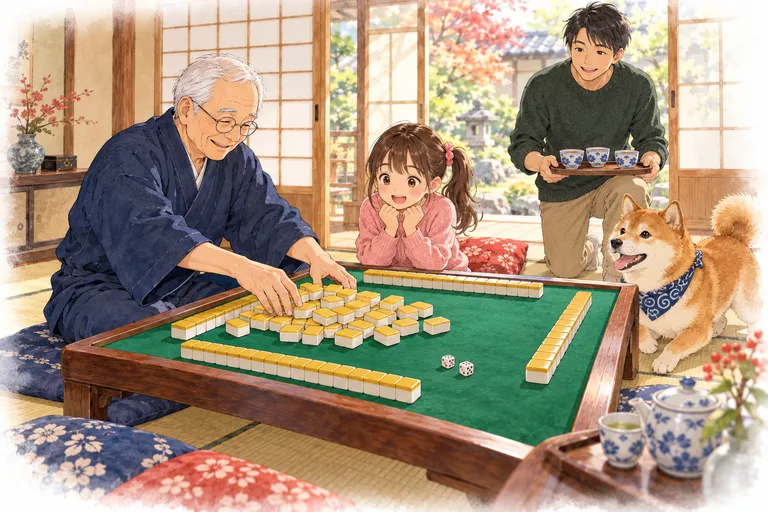
Riichi mahjong, also called Japanese mahjong, is a four-player game played with 136 tiles. Players take turns drawing and discarding; the first to turn their 14 tiles into four melds and a pair while holding at least one yaku wins the hand and collects points from the others. After a full game (usually a hanchan of at least eight hands), the player with the most points wins. This page walks through a hand in the order it is actually played, from building the wall to counting the score, and every section links to the matching chapter of the beginner's guide for more depth.
On this page
- What is riichi mahjong and what do you need?
- The 136 tiles
- Seats, the dealer and the deal
- A turn: draw one, discard one
- Chi, pon, kan and priority
- Tenpai and the winning shape
- The most important rule: you need a yaku
- Rules unique to riichi mahjong: riichi, furiten and dora
- Scoring basics: han and fu
- A full game: hanchan, repeat dealer, honba and riichi sticks
- Beginner strategy: 8 practical tips
- Play a game now
- FAQ
What is riichi mahjong and what do you need?
- Players: four (there is also a three-player version, see three-player mahjong).
- Tiles: 136, with no flower tiles. This site uses one red five in each suit by default.
- Points: everyone starts with 25,000 points, wins collect points from the others, and final placement decides the result.
- Length: the standard game is a hanchan (East and South rounds); a quicker tonpuusen plays the East round only.
At home you need a tile set, dice and point sticks. Here you need nothing: open the free online riichi mahjong game, pick a difficulty and you are playing against three computer opponents, with shuffling, dealing, fu and points all handled for you.
The 136 tiles
There are three suits, each numbered 1 to 9, four copies of every tile:
There are seven honor tiles, also four of each: the four winds East, South, West and North, and the three dragons White, Green and Red.
- Terminals and honors are the 1s, 9s and honor tiles; simples are 2 through 8. Many yaku depend on this split.
- Red fives: one 5 in each suit is red . Each one in your winning hand adds 1 han (it counts as dora, not as a yaku).
Every tile is described in The Tiles.
Seats, the dealer and the deal
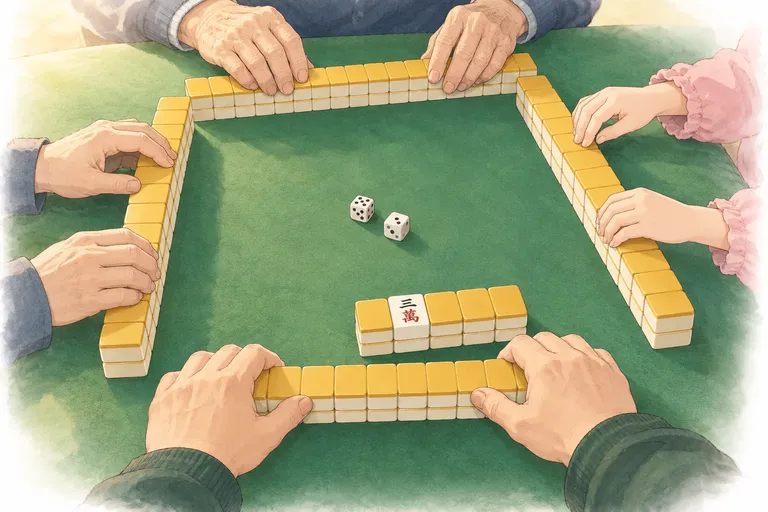
- Seat winds: the four seats are East, South, West and North. East is the dealer; the other three are non-dealers.
- Build the wall: shuffle the 136 tiles face down; each player builds a wall two tiles high and 17 tiles long, and the four walls form a square.
- Roll the dice: the dealer rolls two dice to decide which wall to break and where.
- Deal: everyone takes 13 tiles; the dealer takes one extra (14) and makes the first discard.
- Dead wall and dora indicator: the last 14 tiles of the wall are the dead wall and are never drawn normally. One of them is flipped as the dora indicator; the tile after it is this hand's dora.
A turn: draw one, discard one

- The dealer goes first, then play moves counterclockwise: after you discard, it is the turn of the player on your right.
- On your turn draw one tile and discard one. You normally hold 13 tiles, and 14 only at the moment you win.
- Discards are placed in front of you in rows of six; this is your pond. Everyone can see what everyone has thrown, and that is the main clue for defense.
- If the live wall runs out with no winner, the hand is an exhaustive draw: players in tenpai collect a total of 3,000 points in no-ten payments from those who are not.
The details of every step are in How a Turn Works.
Chi, pon, kan and priority
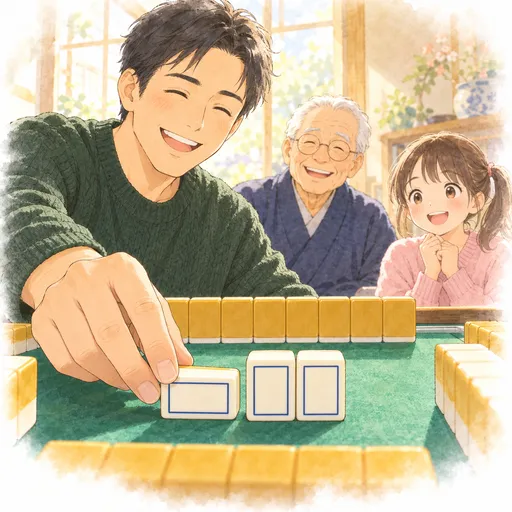
You can take another player's discard to complete a set. This is called calling (an open meld):
| Call | Requirement | Whose discard |
|---|---|---|
| Chi | Completes a run, e.g. takes | Only the player on your left |
| Pon | You hold two of a tile and take the third for a triplet | Anyone |
| Open kan | You hold three of a tile and take the fourth | Anyone |
- Drawing the fourth tile yourself lets you declare a closed kan; drawing the fourth tile for a triplet you already ponned lets you add a kan. After a kan you draw a replacement tile from the dead wall and another dora indicator is flipped.
- If several players want the same discard: ron > pon and kan > chi. A pon skips anyone in between and the caller discards next.
- Calling makes your hand faster but it is no longer closed: you cannot declare riichi, and pinfu, iipeikou and menzen tsumo no longer count. Before you call, make sure you will still have a yaku.
- This site forbids kuikae (swap-calling): right after a chi or pon you may not discard the same tile, or the tile at the other end of the same run.
Tenpai and the winning shape
A winning hand of 14 tiles splits into four melds and one pair. A meld is a run (three consecutive tiles of one suit) or a triplet (three identical tiles); the pair is two identical tiles.
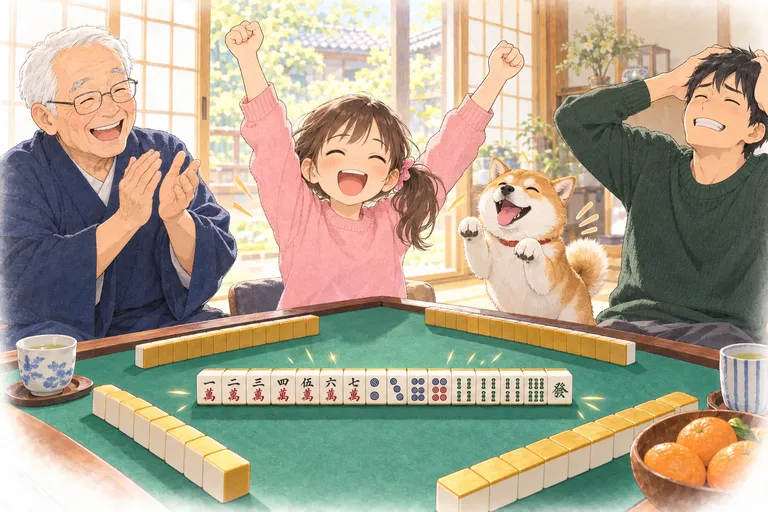
Being one tile from a complete hand is called tenpai. The hand below waits on or , the best kind of wait, a two-sided wait:
- Tsumo: you draw your winning tile yourself and call "tsumo"; all three opponents pay.
- Ron: another player discards your winning tile and you call "ron"; only the discarder pays, which is called dealing in.
- There are two exceptions to the shape: seven pairs (chiitoitsu), seven different pairs, and thirteen orphans (kokushi musou), one of each terminal and honor plus one duplicate, which is a yakuman.
The five kinds of waits and shanten counting are in The Winning Hand.
The most important rule: you need a yaku
This is the big difference from other mahjong styles: a complete shape is not enough, you must hold at least one yaku to win. Dora and red fives only add han; they are not yaku.
The yaku beginners use most:
- Riichi: declare it when your closed hand is in tenpai, 1 han. Even with no other yaku, riichi lets you win.
- Menzen tsumo: win by self-draw with no calls for 1 han.
- Tanyao: only simples, 2 through 8. On this site it also counts with calls (open tanyao is on).
- Yakuhai: a triplet of White, Green or Red dragons, your seat wind or the round wind, even if called.
- Pinfu: closed, all four melds are runs, the pair is not a value tile, and a two-sided wait.
- Chiitoitsu: seven different pairs, 2 han.
Every yaku and its han value is in the yaku list; to start, the first yaku to learn are enough.
Rules unique to riichi mahjong: riichi, furiten and dora
Riichi
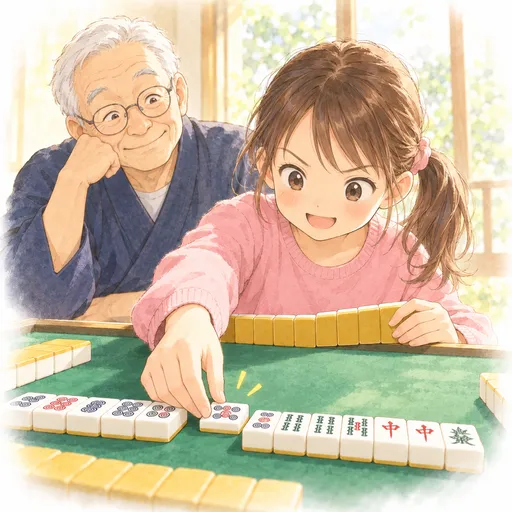
When your hand is closed (no chi, pon or open kan) and in tenpai, you may declare riichi: discard your tile sideways and put a 1,000-point riichi stick on the table. You need at least 1,000 points and at least four tiles left in the wall. After riichi you cannot change your hand, and any tile that does not win is discarded (the game does this automatically), but a win can add ippatsu and ura dora. If your declaration tile is ronned, the riichi does not count and you do not pay the stick.
Furiten
If any of your winning tiles is in your own pond, you cannot win by ron, only by tsumo. This is furiten. There are two more kinds: if you pass on a winning discard, you cannot ron until your next discard (temporary furiten), and if you pass on one after riichi, you cannot ron for the rest of the hand (riichi furiten).
Dora
Each dora in your winning hand adds 1 han. There are three kinds: the tile after the dora indicator, the red fives, and ura dora, revealed only when a riichi player wins. A kan flips another indicator (kan dora). Dora only add han; they never count as a yaku.
Furiten and defense are covered in Furiten and Defense.
Scoring basics: han and fu
Points come from two numbers:
- Han: the han of all your yaku plus your dora. Each extra han roughly doubles the score.
- Fu: how hard the hand was to build. Start at 20, add 10 for a closed ron or 2 for tsumo, add more for triplets and for closed, edge or pair waits, then round up to the next 10. Most hands are 30 or 40 fu.
For a non-dealer ron at 30 fu, 1 han is 1,000 points, 2 han 2,000 and 3 han 3,900. From 5 han, fu no longer matters: it is a mangan, 8,000 points (12,000 for the dealer). A dealer win pays 1.5 times as much as a non-dealer win.
Let's score the tenpai hand from above. After riichi, an opponent discards and you call ron:
Riichi · Ron
| Riichi | 1 han |
| Tanyao | 1 han |
| Pinfu | 1 han |
| Red five | 1 han |
| Total | 4 han 30 fu · 7,700 points |
|---|
Non-dealer, East round, no dora, no honba.
On a tsumo the payment is split three ways: when a non-dealer self-draws, the dealer pays half and each other non-dealer a quarter. For example, a 1 han 30 fu tsumo is "300 / 500" points (each non-dealer / the dealer).
The full score table and fu rules are in Scoring: Han and Fu.
A full game: hanchan, repeat dealer, honba and riichi sticks
- Hanchan: four hands in the East round plus four in the South round, at least eight hands, with the dealer seat moving East → South → West → North. A tonpuusen plays only the East round.
- Repeat dealer: if the dealer wins, or is in tenpai at an exhaustive draw, the same player deals again.
- Honba: a repeat or a draw adds one honba counter; each one adds 300 points to the next win. It resets when a non-dealer wins.
- Riichi sticks: sticks on the table go to the next player who wins; any left at the end of the game go to first place.
- End of game: the game ends after the last hand. If nobody has reached 30,000 points it extends into the West round; if anyone drops below 0 it ends immediately (bust).
- Final score: subtract 30,000 from your points and divide by 1,000, add the placement bonus (uma: +15 for 1st, +5 for 2nd, the same amounts subtracted for 3rd and 4th), and first place also takes the oka of +20.
Repeat dealers, abortive draws and end conditions are explained in How a Match Works.
Beginner strategy: 8 practical tips
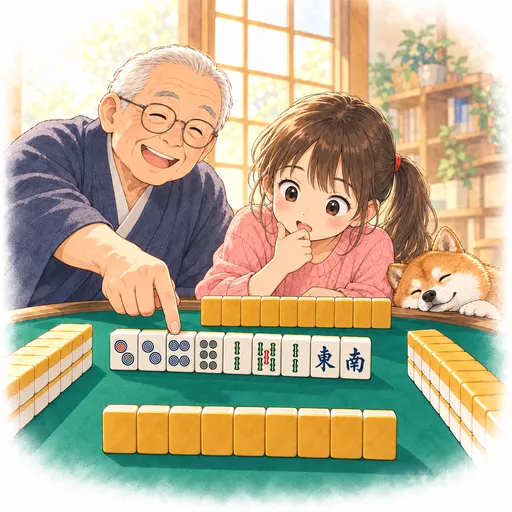
- Throw isolated honors and terminals first: keep easy-to-connect tiles like 3 to 7.
- Riichi when you reach tenpai: if your hand has no yaku, riichi is the easiest one, especially with a two-sided wait.
- Call sparingly: ask "will I still have a yaku?" before calling, and play mostly closed as a beginner.
- Keep pairs of value tiles: two of a dragon, your seat wind or the round wind are worth holding; one pon gives you a yaku.
- Prefer two-sided waits: a two-sided wait has up to 8 winning tiles, a closed or edge wait only 4.
- Watch your own pond: if you have discarded one of your winning tiles, you are furiten and can only win by tsumo.
- Defend when someone declares riichi: if you are far from tenpai, tiles already in the riichi player's pond (genbutsu) are the safest.
- Start with tonpuusen: it has half the hands of a hanchan; move up once you are comfortable.
Play a game now
You now know enough to sit down at the table. This riichi mahjong game is completely free with no sign-up: open your browser and play against three computer opponents.
- Three difficulty levels: easy, normal and hard.
- Beginner help: shanten count, waits with tiles remaining, furiten and no-yaku warnings, and a suggested discard.
- Every win lists the yaku, han, fu and points one by one, so you learn as you play.
Start playing riichi mahjong for free, or first read the first chapter of the guide to learn every button on the screen.
FAQ
How is riichi mahjong different from other mahjong?
Each player holds 13 tiles and there are no flowers. Its defining feature is that you need a yaku to win, along with rules such as riichi, furiten and dora. Scores are counted in han and fu, and everyone starts with 25,000 points.
Why can't I win even though I'm in tenpai?
There are two common reasons. Either you have no yaku (for example you ponned ordinary number tiles and have no tanyao or value tiles), or you are furiten (you discarded one of your winning tiles yourself), in which case you can only win by tsumo.
Can I win with only dora?
No. Dora, red fives and ura dora only add han; they are not yaku. You need at least one yaku, such as riichi, before dora are added.
Do I always have to pay the riichi stick?
Yes. When riichi takes effect you put out a 1,000-point stick, which goes to the next player who wins. Only when your declaration tile is ronned does the riichi fail, and then you do not pay.
Which yaku should beginners learn first?
Riichi, menzen tsumo, tanyao, yakuhai and pinfu. Those five cover most winning hands. The full list is in the yaku list.
How long does a game take?
A hanchan has at least eight hands and a tonpuusen at least four; repeat dealers and draws add more. If you are short on time, start with a tonpuusen.
Do I need to download anything or sign up?
No. It runs in your browser on phones, tablets and computers, and your game in progress and your stats are saved in your own browser.
Try it at the table
Riichi Mahjong — Play Japanese Riichi Mahjong free in your browser against three AI opponents. Standard online rules with red fives, ippatsu and ura dora, a yaku guide, wait and furiten hints, and three AI levels. No sign-up.